The night has a kingdom.
It is preparing to let go.
Beyond the Nomad, the sky has become a story.ENTER THE CHAMBER ↓THE PERSON BETWEEN TWO UNIVERSES
There is a world upon the wall.
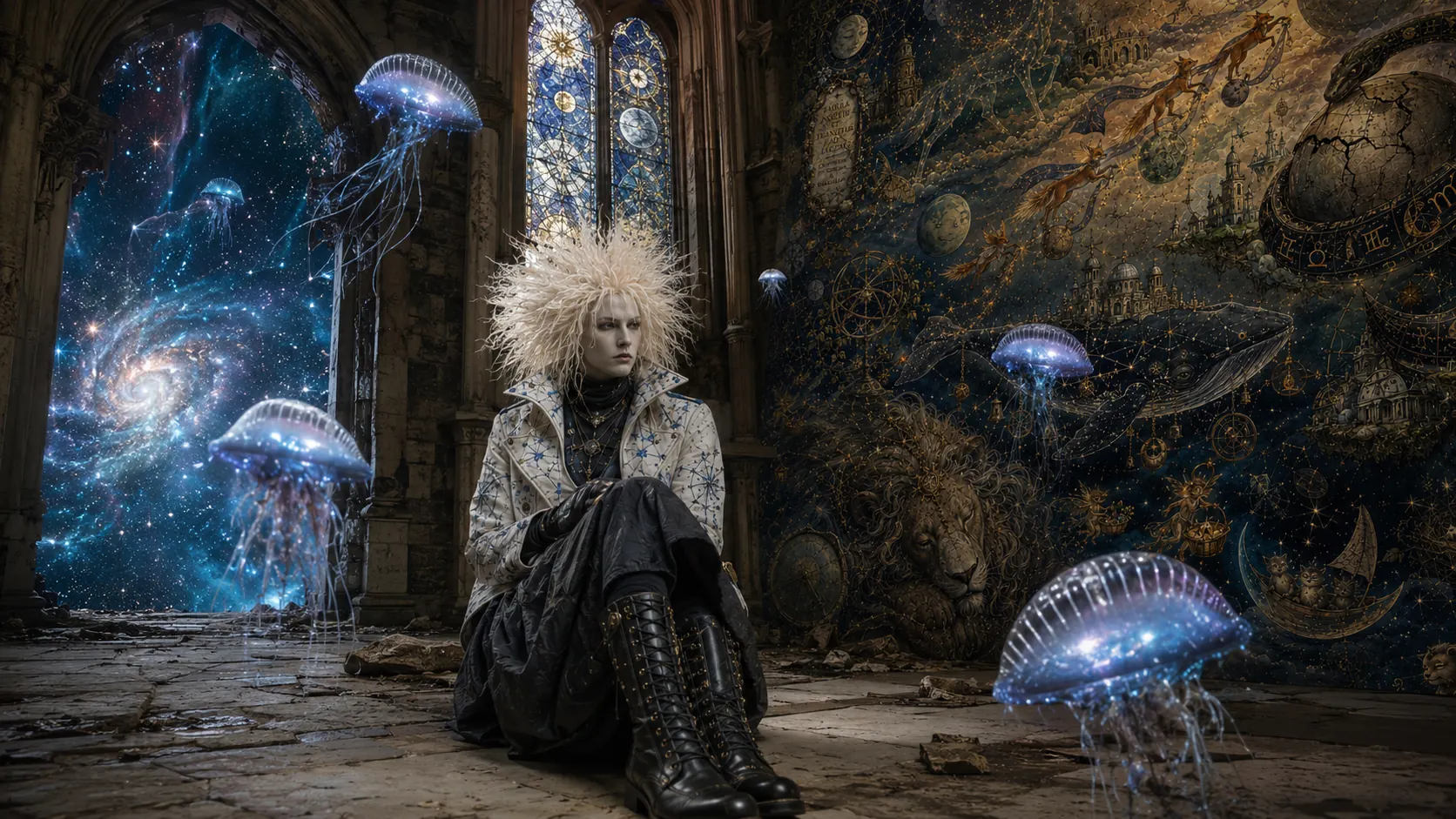
The Celestial Nomad sits on the worn floor of a vast, half-ruined chamber. Old stone rises around him. High stained-glass windows seem to have trapped the movements of planets in their coloured panes. Behind him a great door stands open, and beyond its arch there is no garden, no corridor, no road—only a blue galaxy turning in the dark.
The strangest thing in the room, though, is the wall.
An early illustration of the chamber, where the Nomad sits between a painted kingdom and an open galaxy.
One world can be read. Another cannot.
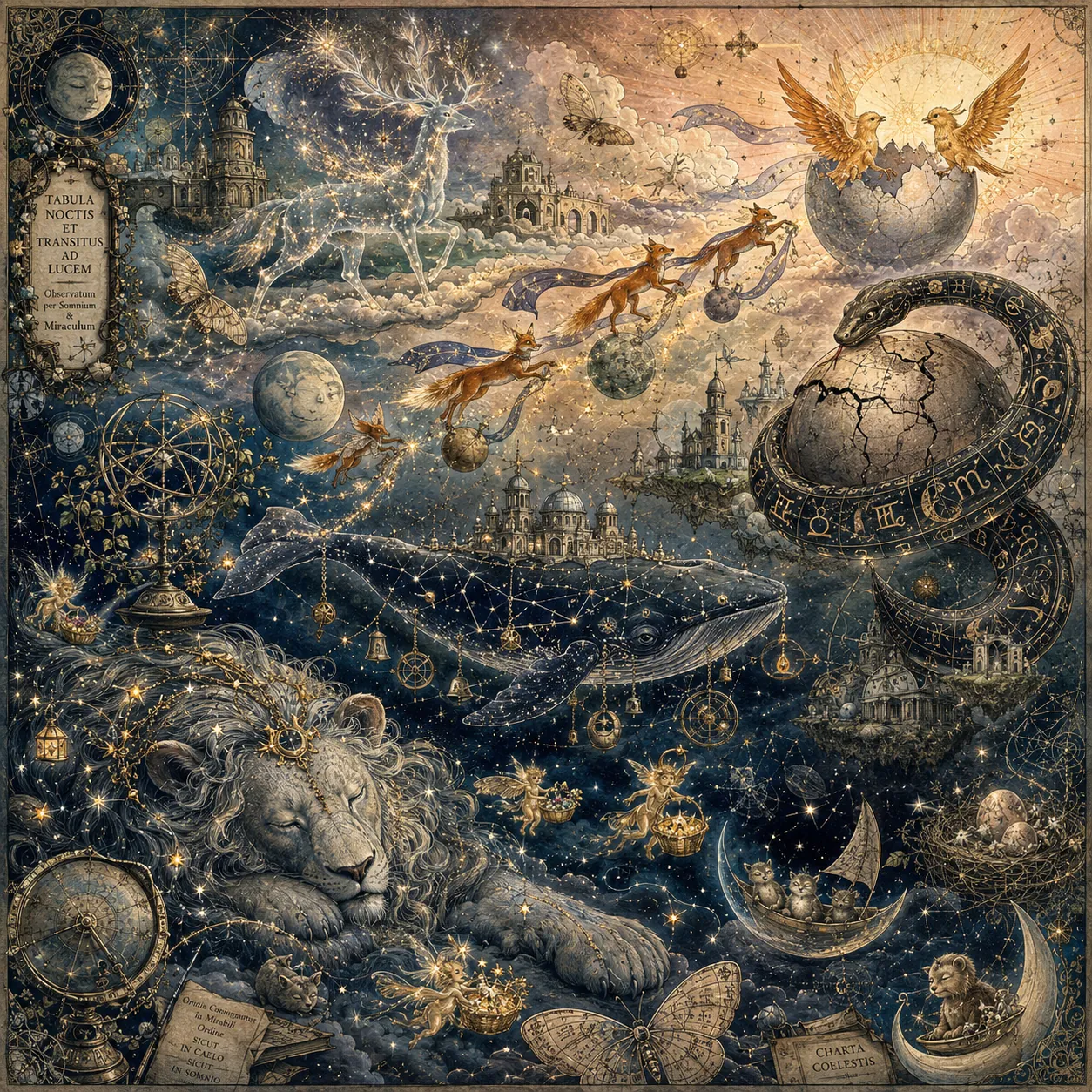
The mural's creatures carry the last stars towards morning. Beyond them, a galaxy opens through stone. The Nomad sits between a story with an ending and a space without one.
EXAMINE THE ORIGINAL MURALThe Night KingdomA door beyond the story.
The figures on the wall follow an ancient ceremony. The moon-lion sleeps; the whale carries; the foxes travel; dawn arrives. But the open doorway refuses the comfort of such a complete procession. Outside is a spiral galaxy too vast to measure against the stone floor. Its light pours into a ruined room without telling us what lies beyond it.
Then the jellyfish cross the threshold, suspended in air as though the building has been lowered to the floor of some invisible sea. Their bodies are almost transparent. They carry their own blue light in small shifting points; their fine tendrils trail behind as they float. Unlike the foxes, they have no visible destination. Unlike the lion, they have no marked duty. Their motion is receptive rather than ceremonial.
Read the complete Epiphany and Galaxy Door stories
The Celestial Nomad sits on the worn floor of a vast, half-ruined chamber. Old stone rises around him. High stained-glass windows seem to have trapped the movements of planets in their coloured panes. Behind him a great door stands open, and beyond its arch there is no garden, no corridor, no road—only a blue galaxy turning in the dark.
The strangest thing in the room, though, is the wall.
Across it spreads an entire night kingdom. In the deep indigo below, an enormous lion sleeps with constellations caught in its mane. It does not look defeated by the coming day. It looks as though it has kept watch over the sleeping hours and can finally rest. Around its paws, little dream-bearing creatures gather fallen stars. A crescent moon has become a boat, just large enough to hold its passengers above the darkness.
Above them, an immense whale travels through a sky of diagrams and starlight. Little observatories and bells hang from its body. Its constellations make it look both ancient and impossibly alive—as though a whole universe could be carried across the night without making a sound.
Higher still, comet-tailed foxes leap from one wandering planet to another. They trail ribbons of twilight behind them. A luminous stag, its body drawn from stars, steps over the clouds towards a warmer horizon. Around them are moths and old astronomical instruments, planetary nests and tiny temples, all joined by the peculiar order of a storybook cosmos.
And at the upper edge of the kingdom, dawn is beginning. Two young sunbirds open their wings from a cracked celestial egg. Nearby a zodiac-marked serpent coils around an ancient fractured planet, guarding rather than attacking. Nothing has to be thrown away so that morning can arrive. The keepers of night have brought its dreams, memories and scattered lights to the threshold of another day.
This is not an ordinary sunrise. It is a handover. The world is imagined as alive with its own ceremonies, its own responsibilities, its own small acts of care. Darkness does not lose a battle. Night passes the sky to Morning, and the heavens change without forgetting what they have held.
The Nomad remains beneath this extraordinary image. In the mural, creatures know what they have come to carry and where they are taking it. In the chamber, he has no such map. The difference gives the scene its quiet ache: a universe full of meaning arranged around someone who cannot simply command that meaning for himself.
Then there are the jellyfish. Blue, translucent, impossibly delicate, they drift through the air with the unhurried movement of creatures borne by water. They belong neither to the painted procession nor to the stone architecture. They pass in front of the Nomad and across the open galaxy like thoughts that have arrived before words can be found.
The mural offers a story that can be followed from dark to light. The doorway offers an infinity that cannot be gathered into any single story. The Nomad sits between them, while a world of creatures, planets and signs carries on becoming something new.
He has not reached an answer. But for a moment, everything seems to be asking one.
The figures on the wall follow an ancient ceremony. The moon-lion sleeps; the whale carries; the foxes travel; dawn arrives. But the open doorway refuses the comfort of such a complete procession. Outside is a spiral galaxy too vast to measure against the stone floor. Its light pours into a ruined room without telling us what lies beyond it.
Then the jellyfish cross the threshold, suspended in air as though the building has been lowered to the floor of some invisible sea. Their bodies are almost transparent. They carry their own blue light in small shifting points; their fine tendrils trail behind as they float. Unlike the foxes, they have no visible destination. Unlike the lion, they have no marked duty. Their motion is receptive rather than ceremonial.
The original illustrated companion imagined these creatures as thoughts before language, and the doorway as an openness to mystery rather than possession of truth. That is the difference between the two halves of the room. The mural gathers images into a coherent fable; the galaxy opens onto something that no single image can contain.
The Nomad sits where those ideas meet. Behind him is a story of the heavens being handed carefully from night to morning. Before him is an infinity that makes no promises. The scene leaves him—and the visitor—between a beautiful explanation and the unsettling possibility that the universe will always be stranger than any story told about it.
A shell has broken. A light is calling.
OPTIONAL: SKIP TO THE MOTHThe Celestial MothBEYOND THE FIRST LOOK
The image, the art video and their meanings.
The early illustrated symbolism and the later mural-specific creative brief are different sources. Explore each in its own terms.
The original illustrated story
Arrangement and the Open Infinite
The early companion called this scene The Epiphany Room, a chamber where mythic figures and astronomical instruments gather into a pattern. Its mural does not promise a final answer.
The Galaxy Door introduces a different possibility: a beautiful uncertainty. The floating jellyfish were imagined as thoughts before language. The Nomad is surrounded by symbols that can be read, and by a mystery that cannot be owned.
The later moth and butterfly-like wings stand for change without erasure; the Atlas Elephant carries a broken world rather than repairing it by force.
How the Night Kingdom was imagined
A celestial procession towards morning
The artist's image brief describes the secret handover from Night to Morning. Mythical beings carry the last stars, twilight, memory and dawn-fire towards a new day. Victorian natural history and antique astronomy are woven into the same fairytale universe.
The original stand-alone collage was later recognised within a separately developed chamber study and the finished art video scene. These images share a strong compositional relationship; the exact intermediate image-generation steps have not been established.
The room lets us see the mural as a story in its own right while holding the Nomad's experience separate from the creatures' imagined ceremony.