THE CELESTIAL ARCHIVE / ROOM II
02 / 06
THE
THRESHOLD
A door in the world.
A change in what can be trusted.
There is nothing gentle about the pyramid. Across the pale desert it rises like a question cut into stone. The Nomad can see the way in. He cannot know what entering will do to the world he thought he understood.
APPROACH THE ENTRANCE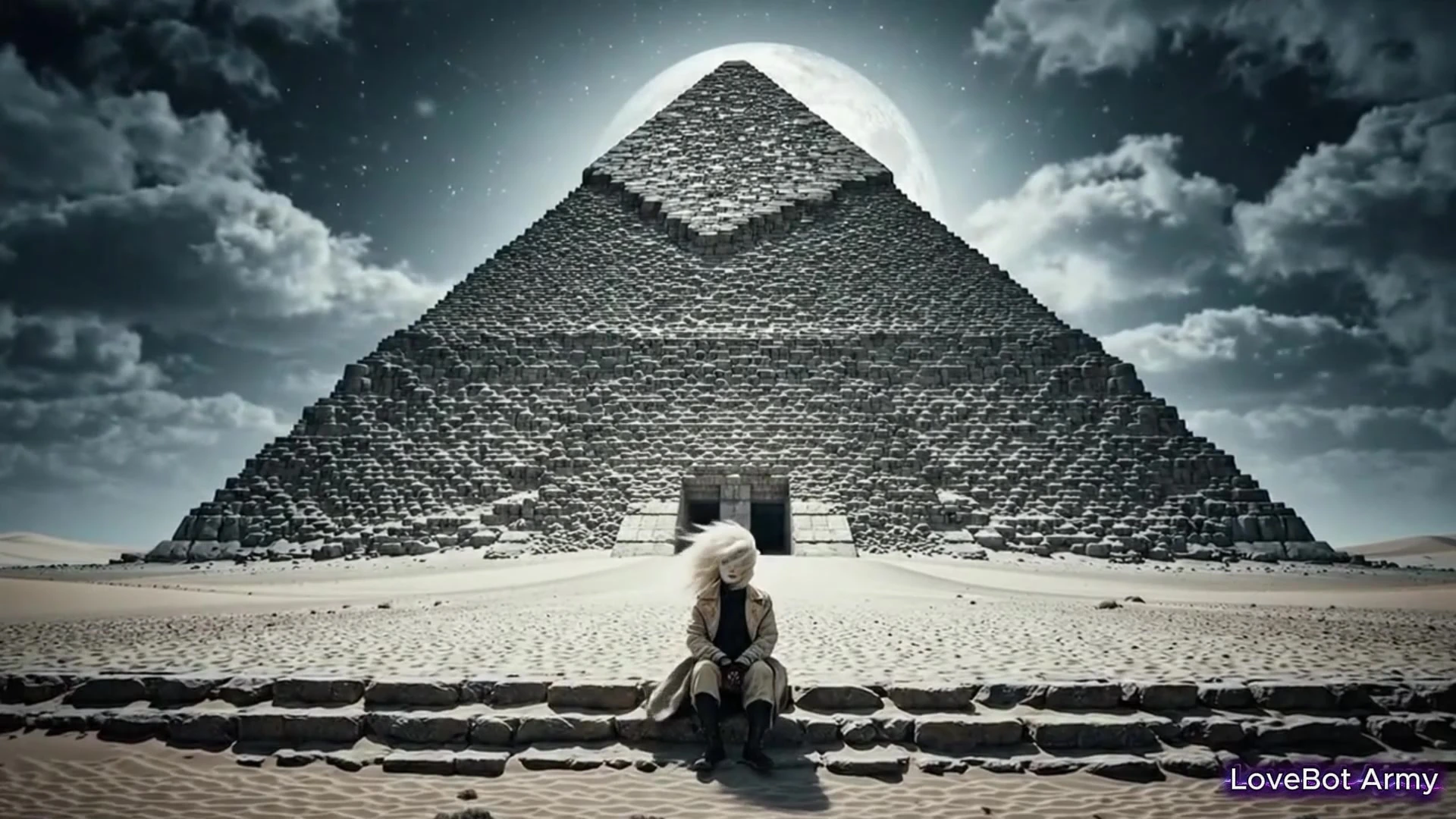
THE THRESHOLD · THE ROOM STORY
A passage, not a promise.
For a moment, the Nomad is still beneath the open sky. Above him stands a pyramid so large that its entrance seems scarcely big enough for a person. The desert offers distance and light, but no answer.
He approaches the dark opening. Stone replaces the horizon. Inside, the world narrows to a floor, enclosing walls and a distant square of brightness. There is a direction to follow, though nothing tells him what waits at its end.
Then the passage begins to change. Marks appear where there had been darkness: strange creatures, planetary forms, lines and celestial signs. They ask to be read, but offer no reliable translation. In the early illustrated story, fear has begun to take the shape of symbols. Understanding has not yet arrived.
For the Nomad, this is more than a change of scenery. His familiar way of perceiving the world is giving way. The audience may be drawn towards the wonder ahead, while he cannot be sure what to trust.
The doorway lets him pass. It does not tell him where he is.
INSIDE THE THRESHOLD
FINISHED ART VIDEO · 00:35THE APPROACH / THE LAST ORDINARY MOMENT
Small before
the impossible.
The sand is almost colourless. The sky is restless. Above him, the pyramid fills the horizon, its doorway no larger than a mark on the stone.
He can still see where he came from. He cannot see what waits inside.
The person beneath the stone
The image is built around a difference in scale. The Nomad is small enough to disappear against the pyramid's face. The stone fills the sky; his body occupies only a little of the ground. The scene makes a threshold feel larger than a decision.
Look for the dark mark in the pyramid before looking at the figure. That narrow opening is the only apparent way forward.
 THE ENTRANCE · 00:40
THE CROSSING / WHERE SIGHT FALTERS
There is light
behind him.
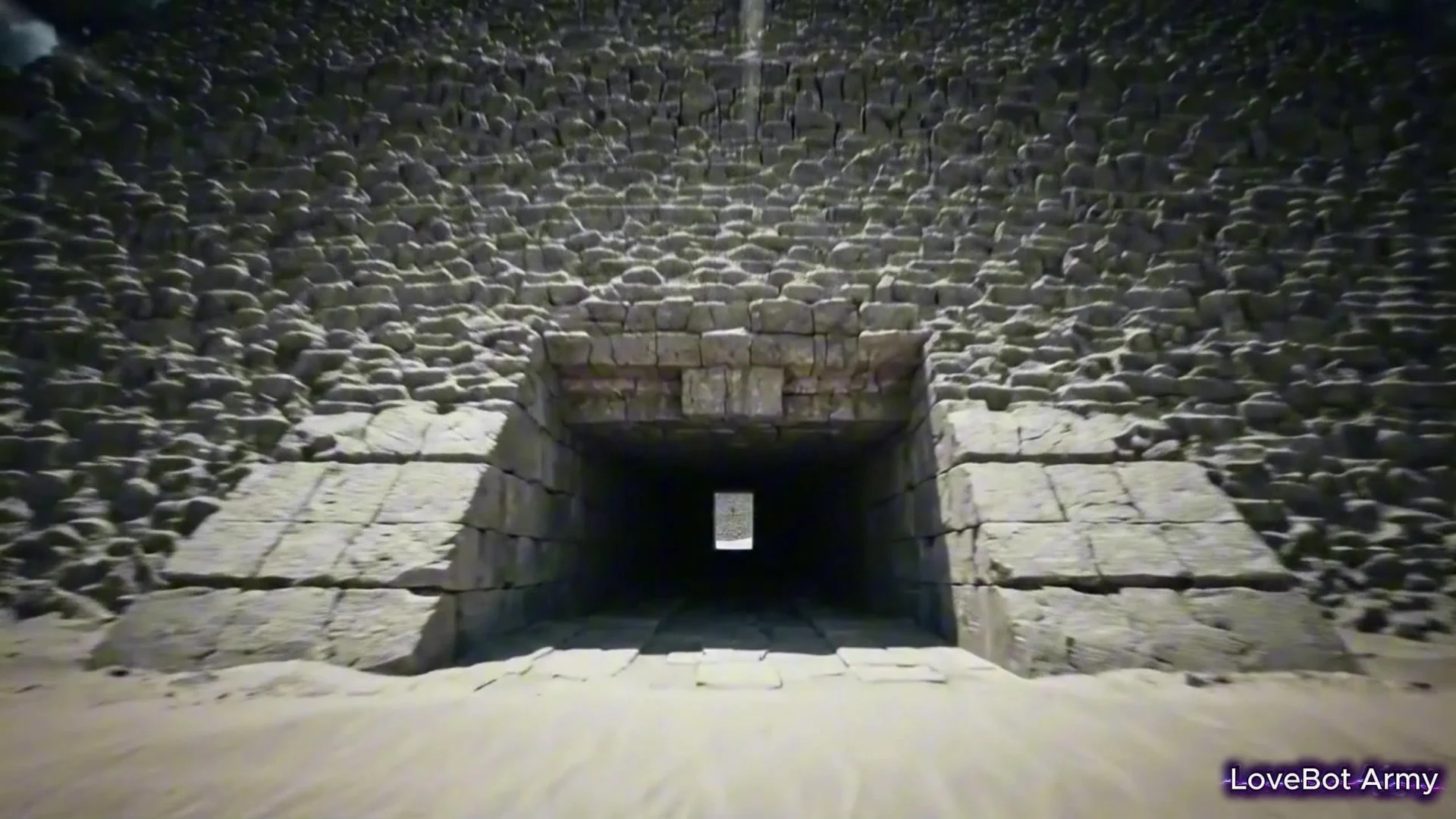
At the entrance, the world narrows into a dark rectangle cut into stone. Inside, a faint square of light remains ahead. Move between the two views: crossing is not the same as knowing where the passage leads.
The doorway marks the boundary between the world he knew and the one he now perceives. To him, the experience is real—even as his trust in ordinary reality begins to change.
A doorway that gives nothing away
Closer to the pyramid, the entrance has become a flat black rectangle beneath enormous blocks of stone. It has no sign promising safety and no view of a destination. The closer the Nomad comes, the less there is to see.
The early symbolic notes describe the pyramid as a passage rather than a refuge. This is a threshold that can be entered, not an answer that can be read from outside.
Darkness still has a direction
Inside, stone surrounds the view. There is scarcely enough detail to distinguish passage from shadow. Yet a small square of light remains ahead, and the edges of the corridor give the darkness a shape.
The early story calls this The Black Passage. Its tension comes from losing familiar bearings while still being compelled to move through a space that has a beginning and an unseen end.
 FINISHED ART VIDEO · 00:47
THE SIGNS / THE PASSAGE BECOMES A LANGUAGE
The walls
begin to speak.
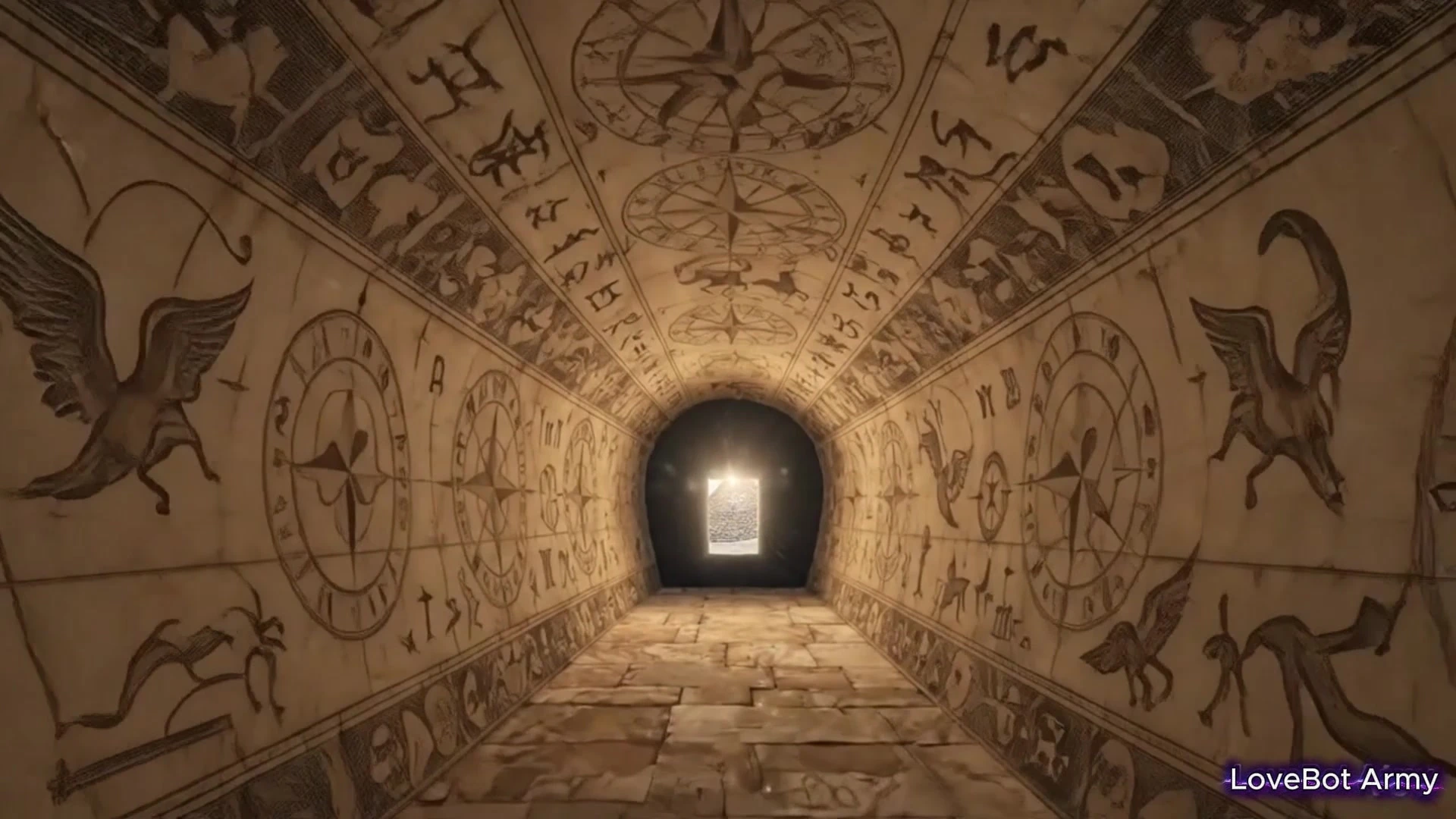
Beyond the dark, the passage changes. What looked empty is crowded with marks: planets, creatures, astronomical shapes and signs whose meaning refuses to settle.
The illustration imagines a passage covered in celestial signs. In the finished art video, those markings surround the Nomad as he moves towards the light. Switch between the two views and notice what changes.
Signs before understanding
The passage is no longer empty. Planetary shapes, creature emblems and imaginary celestial markings appear on the sandstone. The marks are recognisable as signs without becoming a known language that can be translated.
In the original story, what frightened the Nomad begins to take symbolic form; it has not become a message the visitor can decipher. Look at the brightness ahead, then return to the crowded walls.
Imagining the same threshold in another image
The original artwork explores a densely marked corridor leading towards a square opening. The finished art video frames an apparently material sandstone passage with invented symbols and a light beyond.
Both images ask how an unfamiliar experience might become a place with weight, walls and a direction of travel. One is a drawn vision; the other lets us follow the Nomad through the passage.
BENEATH THE PASSAGE
Two ways to understand the crossing.
The early illustrated story described the symbolic stages of the passage. The artist later spoke about why the pyramid mattered to the art video. These are related, but distinct, perspectives.
The original symbolic story
Three thresholds, not three answers
In the first illustrated story, the crossing carried three distinct meanings. The pyramid was more than a magical doorway.
The Pyramid is the threshold from surface life into the unknown self. It marks a moment before rupture: the possibility of descent, initiation and eventual return. The early text does not promise that entering will be comforting or restorative.
The Black Passage represents the fear and disorientation of losing familiar identity and orientation. The tunnel creates a paradox: the Nomad may feel lost, yet the darkness has the shape of a corridor. There is still a way through, even though the story does not guarantee what waits beyond it.
The Hieroglyphic Passage is the point where fear begins to take visible form. The walls acquire strange markings. A void becomes crowded with signs, and the Nomad has something to look at before he has anything he can understand.
These imaginary signs and passages belong to the Nomad's inner journey. They are not meant to be read as real ancient inscriptions.
The artist's later reflection
Why the pyramid?
In the artist's later recollection, the pyramid offered a recognisable but mysterious entrance into the Nomad's altered experience of reality. Its associations with ancient monuments and the heavens were personally compelling visual ideas—not claims about the historical purpose or secret meanings of actual pyramids.
The artist identified this part of the fictional journey with the onset of psychosis. The threshold is therefore not simply an entrance to a fantasy destination. It marks a change in what the Nomad believes he is seeing, and in his ability to distinguish the familiar from the strange.
The artist also wanted the universe beyond the pyramid to be extraordinarily beautiful. That creates a deliberate tension between perspectives. A viewer may feel wonder where the person inside the story experiences uncertainty, distress or confusion.
Beauty does not erase his fear, and his fear need not make every image look frightening.
THE THRESHOLD / THE FIRST ARRIVAL
The darkness opens.
Wonder rushes in.
The passage has brought him to the edge of another way of seeing. There is light ahead. There is still no certainty.
At the entrance, the Nomad could see where he had come from but not where he was going. The threshold has given him a path into another world. It has not made that world easier to understand.